Healing Through Art: How Creative Play Supports The Nervous System
There is something deeply healing about making art and I heard this from so many fellow professional artists and creators I’ve talked to, but also from people who do not consider themselves artists, but practice art as a hobby.
Today we talk about that type of art making that helps us heal and promote our well-being. We do not talk about professional art, but that art that involves only pure play. Not productivity. Not performance. Not improvement - but play ( My personal story from the last part of the blog will explain this difference in detail).
So, what is Creative Play? Creative Play is the moment when you allow yourself to explore any art practice without pressure. When you create without caring if it is “good.” This is actually where most of the adults who do not consider themselves creative fail to understand:
Creative play is not childish. It is biological wisdom. We all have it. We all can use it. We all can benefit from it. Your well-being will highly benefit from it, for sure!
So let’s clarify today slowly but shortly how your well-being can highly benefit from creative play!

August Play From the seriesThe Nordic Forecast, 2020, Tampere, Finland
It is about your nervous system - again.
You might have heard already many times (or not) about how your nervous system and your overall well-being are interconnected. I simply say this: it is important to understand how your nervous system works so then you can help yourself whenever you need! There are many fantastic aspects about our nervous system and its ancient wisdom it carries but let’s keep it super simple today! (Join my courses and will discuss this in more details!)
Now here’s your short overview:
Your nervous system is constantly communicating with your organs and sending information throughout your entire body.
If it perceives danger — whether the threat is real or imagined — it shifts the body into alert mode. In this state, the sympathetic nervous system becomes more active. Heart rate increases, muscles tense, breathing may become faster, and attention becomes more focused on the environment. You might feel on edge, hyper-aware, or easily startled.
This response is healthy and necessary in moments of real danger. It is part of our survival system.
However, alert mode is not meant to be the default state we operate in every day. When the body stays in this activated state for long periods, it uses more energy and vital resources. Processes like digestion, immune repair, and long-term healing receive less attention because the body prioritizes survival.
To give you an example - Imagine a car with the brake and the accelerator pressed at the same time. The engine is working hard, but it is under constant strain. Over time, the system wears down faster. The body works in a similar way. It is not designed to remain in constant acceleration.
When you are in creative play mode - meaning you let yourself to play without fear of making mistakes or self-judgment of the final result - through slow looking , gentle body movements — it sends a different message to your whole sysem: You can rest now.We are safe.
This is where healing begins.
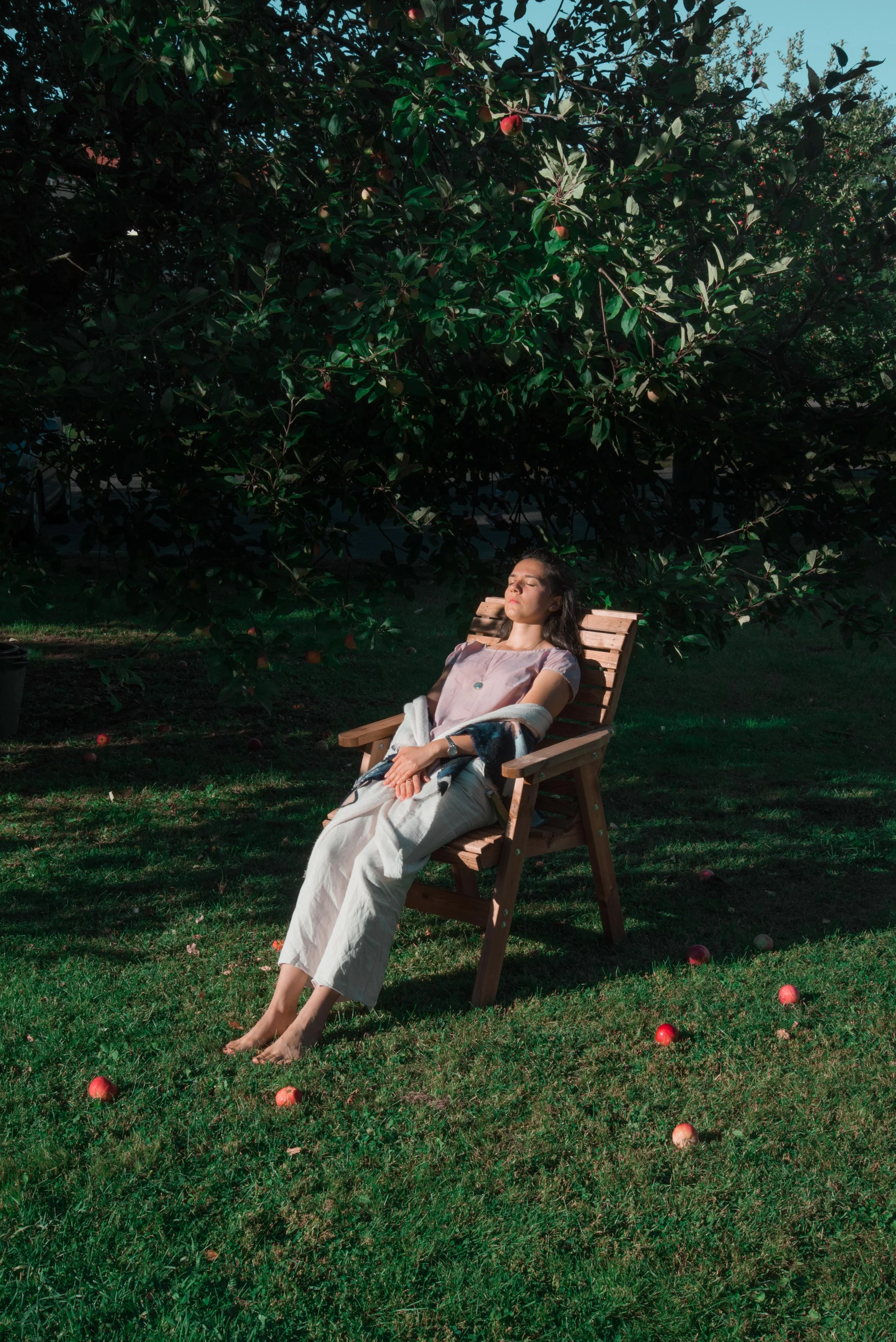
Vitamin D Hunger II From the series The Nordic Forecast, 2020, Tampere, Finland
My Own Turning Point
In 2022, I experienced a severe burnout and was eventually diagnosed with CPTSD (complex post-traumatic stress disorder).
For years, art had been my profession. I was trained in realistic drawing, strong concepts, polished presentation. Art was discipline. Art was performance. Art was achievement.
It was rarely play.
When my nervous system collapsed, I realized that even creativity had become another space of pressure.
Healing began quietly.
I got colored pencils and started drawing from imagination — imperfect shapes, intuitive botanical forms, compositions that didn’t need to be correct. I chose colors based on how they felt in that moment, not based on a “good” palette.
I picked up a guitar without knowing how to play. I touched the strings just to hear the sound. Some notes were awkward. Some were beautiful. I allowed myself not to know.
I went on long photo walks in nature. I stood on stones. I sat in the grass. I stared at trees for long minutes as if I were discovering them for the first time. I photographed the same subject again and again, not to improve it, but to stay with it.
I pressed flowers and made small botanical compositions. I planted seeds without obsessing over the outcome.
I stepped onto the yoga mat for five or ten minutes and moved toward what felt tight, without a goal.
No strict plan.
No pressure.
Just curiosity.
At first, it was difficult. My trained brain wanted results. It wanted coherence. It wanted something “good.”
But slowly, something shifted. And I tell you… it felt SO good. A pleasure and a feeling of freedom I cannot explain, but I am sure you can feel it if you were to try!
When I removed performance, my body softened.
When I removed outcome, curiosity returned.
When I allowed play, healing began.
That space of exploration rewired my relationship with art — and most importantly, with myself. I repetead the process consistently for couple of weeks and started to see results faster than I imagined. While doing it and learning about the science behind what I was doing, things started to make sense. I developed my own method called Creative Harmony to support other people as well and share my knowledge and my creative practices with others. And it worked for them too!
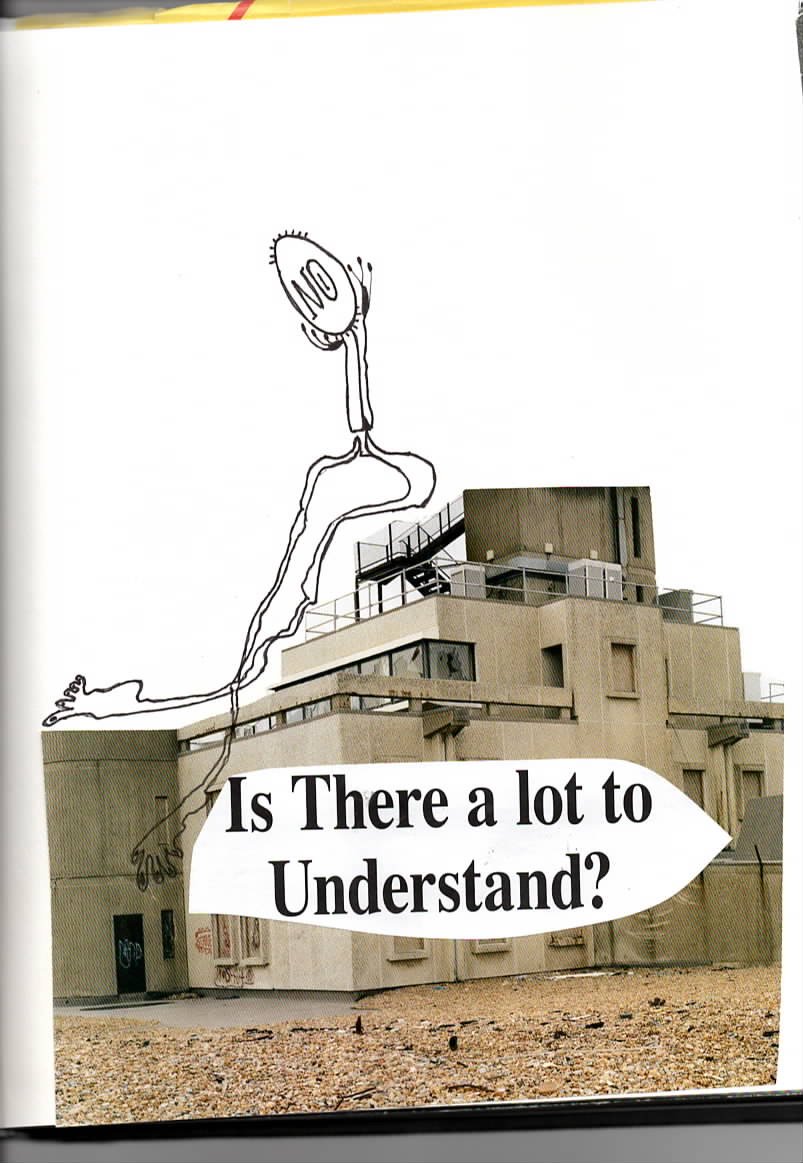
So keep this in mind
Play is for adults, too. Creativity is a human trait. There is nothing to be good or bad at. Allow yourself the luxury of creative play. It is free of charge and can bring huge health benefits.
We often think play belongs to children. But adults need it just as much — maybe even more.
Play allows mistakes. Mistakes allow learning. Learning in safety allows growth.
Laughter helps tremendeously your nervous system, too.
After reading this, I invite you to ask yourself gently one or more of the following questions (use the comments section down below as your notebook if you wish! I’d love to hear from you! ):
What feels playful to me?
What activities make me naturally lose track of time?
What would I explore if no one (including myself) judged the result?
An Invitation to Play: A Slow Photography Weekend for Nervous System Reset (coming up this April)
This April, I am offering a Well-being Photography Course — a gentle introduction to how photography can support your well-being without too much effort or theory - but with non-judgmental play.
As Dr. Christina Davies beautifully said:
“You don't have to be good at art, for the arts to be good for you.”
In this course, we will:
Explore how art influences the brain and nervous system (we’ll go into more details on can learn how to balance yourself in any situation needed)
Learn simple emotional well-being tools ( we’ll look at our emotions from a more simple and playful angle and learn how to be with them instead of running away from them)
Take part in a 2–3 hour outdoor slow well-being photo walk using Creative Harmony with Luiza method (my favourite part! and probably yours too!)
Experiment and play with photography and other arts as well
Reflect on what our images reveal about our inner landscape and how we can use art to support our well-being in the future
You do not need art experience.
You do not need to be “good.”
You only need to allow yourself to be and play.
The atmosphere is calm and inclusive. You can bring a camera or simply your phone. We move step by step — while leaving space for your own creative exploration.
If creative play is the doorway, photography can be the key. I invite you to rediscover that playful part of yourself — the one that knows how to look at the world with wonder and joy.
And maybe, healing will quietly begin there. Are you in?
Bibliography
Kaimal, G., Ray, K., & Muniz, J. (2016). Reduction of cortisol levels and participants’ responses following art making. Art Therapy, 33(2), 74–80.
Bolwerk, A., et al. (2014). How art changes your brain: Differential effects of visual art production and cognitive art evaluation on functional brain connectivity. PLoS ONE, 9(7).
Stuckey, H. L., & Nobel, J. (2010). The connection between art, healing, and public health. American Journal of Public Health, 100(2), 254–263.
Porges, S. W. (2011). The Polyvagal Theory: Neurophysiological Foundations of Emotions, Attachment, Communication, and Self-Regulation.
McEwen, B. S. (2007). Physiology and neurobiology of stress and adaptation: Central role of the brain. Physiological Reviews, 87(3), 873–904.
World Health Organization (2019). What is the evidence on the role of the arts in improving health and well-being? A scoping review.
